
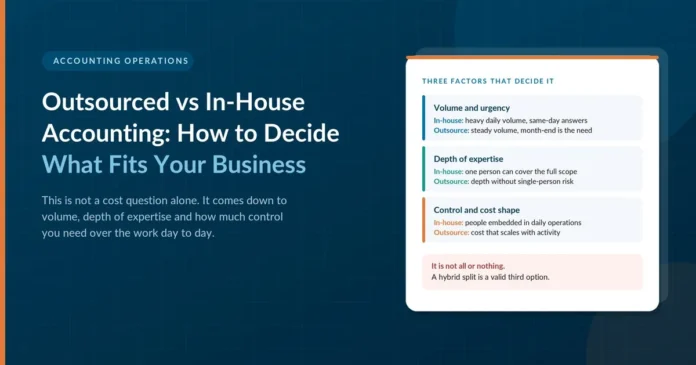
Most owners frame this choice as a price question. Which is cheaper, an employee or a firm? In my experience, that is the wrong place to start.
The better question is what your business needs from its finance function in the next two to three years. A company that needs daily invoice approvals has different needs than one that needs clean monthly reporting and a tax-ready year-end. This guide gives you a way to compare the two options on control, coverage, cost, and growth, and a short decision path at the end.
What You Are Actually Choosing Between
Accounting is not one job. It is a group of tasks that need different skill levels.
At the base is bookkeeping: recording transactions and reconciling accounts. Above that sits accounting: closing the month, preparing financial statements, managing payables and receivables, and coordinating taxes. At the top is finance leadership: budgeting, cash planning, and advising on decisions.
An in-house hire usually covers one or two of those layers well. A full-time bookkeeper rarely has controller-level reporting skills. A controller is often too expensive for daily data entry. Firms that offer outsourcing accounting services spread these layers across a team, so you get different skill levels without paying for each as a full-time role.
The Real Cost of an In-House Accounting Function
A salary is only the starting number. Add payroll taxes, benefits, software, training, and the time you spend managing the work.
Start with your own time, since owners often overlook it. Suppose you spend 10 hours a week on finance tasks and your time is worth $100 an hour. That is 10 × $100 × 52 weeks = $52,000 a year. This is a time cost, not a cash cost. It still shows what the current setup takes from you.
Then look at risk. A single in-house person is a single point of failure. If that person is out for two weeks or resigns, closing the books stops. Rebuilding the process takes months, and the knowledge often leaves with the person.
The Real Cost of Outsourcing
Outsourcing has its own trade-offs, and they are worth naming plainly.
You give up a desk down the hall. Quick questions go through a ticket or a call rather than a hallway chat. You also depend on the provider’s process, so a weak provider can hurt you in a way that an in-house hire might not.
In return, you get set routines, backup coverage, and a team with experience across many companies. The fee is also easier to predict than a salary plus hidden costs. If you are weighing the savings side, this piece on how an accountant can save your time and money on taxes shows how year-round support avoids last-minute costs.
Outsourced vs In-House Accounting: Side by Side
| Factor | In-house | Outsourced |
|---|---|---|
| Daily access | Immediate | Scheduled, usually within a business day |
| Skill range | One or two people, one skill set | A team across several skill levels |
| Coverage for absence | Gaps during leave or turnover | Backup built in |
| Cost structure | Salary, taxes, benefits, software | Monthly fee for a defined scope |
| Scalability | Hire as you grow | Scope adjusts as you grow |
| Control over process | Direct | Shared, set by agreement |
| Management time | You manage the person | You manage the deliverables |
No row decides the question alone. The right choice depends on which rows matter most to you.
Internal Controls: The Factor Owners Miss
Here is a point that rarely appears in cost comparisons. A small in-house team often means one person records transactions, approves payments, and reconciles the accounts. That setup removes the checks that catch errors and fraud.
The idea behind internal controls is simple. No single person should handle a transaction from start to finish. One person records it, another approves it, and someone else reviews the result.
A good outsourced setup separates these roles naturally. The provider records and reconciles. You or a manager approves payments. You review the reports. That split gives you a stronger control structure than one employee working alone, and it costs nothing extra.
What to Keep In-House Even When You Outsource
Outsourcing does not mean letting go of everything. Some functions stay with you:
- Payment approval. You decide what gets paid and when.
- Ownership of accounts. You hold the master login to your bank and software.
- Customer and vendor relationships. You set terms and handle disputes.
- Strategic decisions. The provider supplies numbers, and you decide what to do with them.
This split is the heart of a hybrid model. Many growing businesses keep a part-time coordinator for approvals and daily questions, then outsource the technical work: reconciliations, month-end close, reporting, and tax coordination.
Worker Classification: Employee or Freelancer?
If you are leaning toward a person in-house, you still have a choice. A full-time employee, a part-time employee, or a freelance accountant each carry different obligations.
A freelancer works under their own schedule and tools. An employee works under your direction and follows your processes. The IRS looks at behavior, financial control, and the relationship between you and the worker. Review its guidance on employee versus independent contractor status before you decide. Calling a worker a freelancer does not make them one if the day-to-day reality looks like employment.
Stages Where Each Option Tends to Fit
These are rules of thumb, not fixed lines.
- Early stage, simple operations. Outsourcing often fits. You need clean records and tax readiness, but not a full-time hire.
- Growth stage, rising complexity. A hybrid fits well. You add a coordinator while a firm handles reporting, close, and compliance.
- Established, high transaction volume. In-house may fit if daily processing is heavy and you can staff more than one person. Many such companies still outsource tax, audit support, or specialized projects.
- Multiple entities or locations. Outsourcing helps keep the process consistent across every set of books.
A Simple Decision Path
Work through these steps in order.
- If you cannot name who covers your books when your accountant is out, lean toward outsourcing.
- If one person records, pays, and reconciles, add a second set of eyes before anything else.
- If your reporting runs more than 30 days late, the issue is process, and a provider with a set close schedule can fix it faster than a new hire.
- If you need daily on-site tasks, such as processing checks or handling cash, keep a part-time in-house role.
- If your needs are likely to change within a year, choose the option that scales without a new hiring cycle.
- Test the decision with a 90-day trial and clear deliverables before you commit long term.
Final Thought
Outsourced vs in-house accounting is not a contest with one winner. It is a design decision about who does what, how work gets checked, and how the function grows with you. The best setups combine both: an internal person for approvals and daily needs, and an outside team for depth, coverage, and consistency. Decide on that basis, and the cost comparison tends to settle itself.
This article is for general information only and is not tax or legal advice. Consult a qualified professional about your situation.
About the author: Nimesh Soni, CPA, is the founder of Datastub, an outsourced accounting and bookkeeping firm serving U.S. contractors, ecommerce sellers, and growing small businesses. Crunch. Strategize. Deliver.